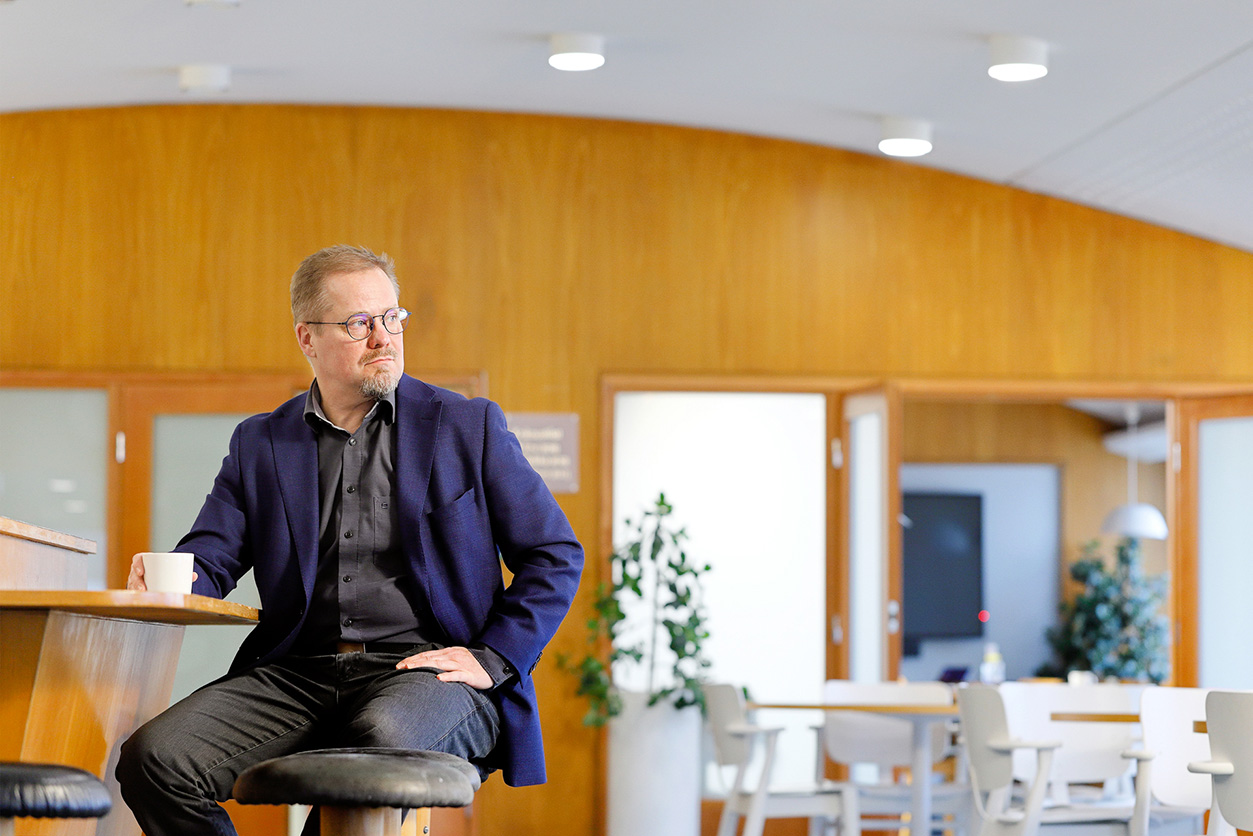
Your eye is drawn first to the top-floor ceiling of the Voimatalo, shaped like an airplane wing. The fine-wood wall panels and a few original pieces of furniture also stand out. The offices of the RTS Group —Building Information Foundation RTS, Rakennustieto Oy and Building Information Model Ltd—are located in the building.
The building was originally completed as the headquarters of Imatran Voima. It was designed by architect Aarne Ervi, who also headed the Standardization Institute of the SAFA in its early days in the 1940s. The RTS Group is the later organizational successor to that work.
In a way, Ervi was an early predecessor of mine in this roleIt has been interesting to notice that my thinking about architecture is, at its core, very similar to Ervi’s
says CEO Markku Hedman.
Today, the building designed by Ervi is home to RTS Group experts whose shared mission is to support a high-quality and sustainable built environment where people can thrive. Hedman himself has pursued the same goal throughout his career.
Design, teaching and research
Markku Hedman’s career has followed parallel paths. He has led the architectural practice he founded for nearly 30 years, specializing in innovative urban and housing design projects. More recent work has focused on developing industrial timber-frame residential construction. His university career began at the same time as he established the practice. Teaching duties at the Helsinki University of Technology later evolved into a professorship at the School of Architecture at Tampere University, where he served from 2007 to 2018. Alongside leading numerous research projects, he found teaching particularly inspiring. In total, Hedman reviewed nearly 400 theses.
Design work, teaching and research clarified his thinking about the significance of architecture and construction.
Architecture is not only artistic expression, functional solutions or technical implementation. Equally important are architecture’s connections to social, environmental and cultural questions. For me, Aarne Ervi and the human-centered, humanist modernism he represented are an important role model.
Results are built through collaboration
When Markku Hedman moved in 2018 from a professorship to the role of CEO of the RTS Foundation, the underlying ethos of his work remained largely the same. For more than 80 years, the purpose of the RTS Group has been to support the delivery of high-quality construction.
In my work as an architect and as a teacher, I have tried to promote sustainable construction. That is why this role suits me extremely well—and continues to motivate me. When I come to work in the morning, I never have to question our goals or our values
Hedman says and continues that he believes the same atmosphere extends across the entire RTS Group.
I believe our staff experience our work as meaningful and impactful.
Together with its partners, the RTS Group has been able to develop its operations to meet the sector’s current needs. According to the CEO, strong results are not attributable to any one individual. They come from succeeding together and from effective cooperation among people, teams, the group’s companies and the foundation.
The Building Information Foundation is a non-profit organization that, through the companies it owns, produces and maintains information products and services that benefit the entire real estate and construction sector.
We want to create products and guidance that generate added value for users—and that strengthen actors’ ability to renew their operations to meet the many needs of the future
he emphasizes.
Succeeding requires top-level expertise, complemented by the RTS Foundation’s committee system. The role of the committees—and the roughly 400 expert members who work in them—is vital for us when it comes to gaining knowledge and practice-based expertise.
The RTS Foundation supports knowledge creation through its own research activities, carried out by a team of eight researchers. It is important that research produces evidence-based knowledge that can be applied in practice and is openly available to everyone, on topics that matter to actors in the real estate and construction sector.
Resilience in silence
The major themes currently being advanced within the RTS Group are multifaceted. One of them is the flow of information, which is linked to standardizing digital and AI-era data structures—so that information can move smoothly between different users and use cases through interfaces.
The flow of information supports effective data-driven management. It is based on reliable information and enables the assessment of overall impacts and multi-objective optimization
Hedman explains.
Other strategic themes relate to preparedness and resilience, as well as sustainability and responsibility. They may sound self-evident today, but in a changing and complex world they contain numerous perspectives on construction.
But how does Markku Hedman prepare and strengthen his own resilience?
I seek out nature and silence. After busy days, for example kayaking or cycling on forest trails is deeply restorative
Markku reveals.
Text: Rami Kangas
Photo: Mikko Käkelä