
The ethical AI playbook 2.0
Artificial intelligence (AI) refers to a computer’s ability to exhibit human-like capabilities, such as reasoning, learning, planning, and creativity. Thanks to AI, technical systems can perceive their environment, respond to what observed, and solve problems with machine assistance, thereby supporting the achievement of desired goals. Simplified, an AI application receives data, processes it, and responds using statistical reasoning.
AI systems can adapt their behavior to some extent by analyzing the effects of previous actions and acting partially autonomously based on this analysis.
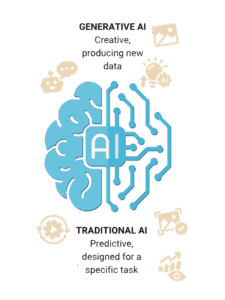
Broadly speaking, there are two types of AI: traditional AI (traditional AI or predictive AI) and generative AI (GenAI). Traditional AI cannot produce new data and usually has a single task for which it is designed. Computer vision and image recognition are typical examples of this type. In contrast, generative AI, which has developed rapidly in recent years, learns from training data and can create new data that resembles the training material. Typical examples of generative AI include ChatGPT, and other AI services developed for producing various natural languages.
Torro (2024) and Abioye et al. (2021) describe practical applications of AI systems that are widely used across the construction industry’s value chain. Examples include automating routine in planning tasks, health and safety monitoring, estimating and forecasting project costs, optimizing supply chain and logistics processes, and identifying risks. In one area, robotics can be applied to construction site monitoring, data collection, prefabrication of building products, and machine control. On the other hand, knowledge-based systems can be used for project bid evaluation, waste management optimization, and assessing sustainability criteria.
The use of artificial intelligence in the AECO sector can be examined from several different perspectives. Abioye et al. (2021) highlight seven areas of AI relevant to the AECO sector:

1. Machine learning

2. Computer vision

3. Natural language processing

4. Knowledge-based systems

5. Optimisation

6. Robotics

7. Automated planning and schedulings
Torro (2024) divides AI systems in the AECO sector into three levels:

Level I (mature technologies): knowledge-based systems and optimization

Level II (emerging technologies): machine learning, automated design, and scheduling

Level III (emergent technologies): computer vision, robotics, and generative AI
The AECO sector is in a divided situation regarding the utilization and development of artificial intelligence: while progress faces challenges, there is also clearly identifiable potential. The construction industry remains one of the least digitalized sectors and encounters difficulties in leveraging AI and other digital technologies. Regona et al. (2022) note that the adoption of AI in construction is slow due to insufficient business models, a lack of AI expertise within the sector, and error-prone processes. Abioye et al. also highlights challenges such as high initial investment costs for AI solutions, trust issues, and limitations in computing power and internet connectivity on construction sites.
At the same time, strong engineering expertise and efforts to ensure data compatibility provide good conditions for developing and utilizing AI applications. Torro (2024) emphasizes that Finland is well-positioned for the development of advanced AI solutions, which also creates a positive development environment for the AECO sector, thanks in part to the high-performance computing capacity of the LUMI supercomputer. AECO sector specific technologies, such as Building Information Modeling (BIM), create new opportunities for applying AI models and their combinations. Interoperability efforts led by the Finnish Ministry of the Environment, along with a wide range of ISO and CEN standards, provide a solid foundation for high-quality AI applications. Without high-quality training data, it is impossible to ensure the reliable performance of AI applications.
AI agents and multi-agent systems
According to Alhava et al. (2025), AI agents represent a significant step forward not only in AI development but also in the digitalization of various industrial sectors, as they enable the automation of entire workflows rather than just individual tasks. Unlike traditional automation solutions, AI agents can, for example, plan, execute, and monitor processes, adapt to set goals, and continuously learn from their experiences.
AI agents are applications trained for specific tasks and capable of independently observing their environment (Kapoor et al., 2024). They can utilize, for instance, generative AI language models to perform their tasks. They can operate as an extension of traditional process automation, with the difference being their ability to learn and modify their behavior based on new data. Alhava et al. (2025) note that this enhances the execution of complex tasks and improves the flow of information between systems and parties.
AI agents can be deployed to perform multiple interconnected tasks, such as selecting construction products, optimizing carbon footprints, or gathering information for product selection. These are known as multi-agent systems, which collaborate, exchange information, and produce results through interaction with one another. They operate according to predefined rules, enabling the distributed solving of complex problems (Alhava et al. 2025).
Gartner (2025) has identified AI agents as one of the most significant technology trends for business development in 2025. This is also reflected in the rapid development of AI agent platforms within the service offerings of major tech companies. Microsoft offers AutoGen Studio, Google has its Agentspace environment, Amazon provides Bedrock Agents, and OpenAI offers Swarm.
Read more
Torro Osku, Tekoälyn hyödyntäminen kiinteistö- ja rakennusalalla, Tampereen yliopisto, 2024, linkki: https://trepo.tuni.fi/bitstream/handle/10024/157306/978-952-03-3451-2.pdf?sequence=2&isAllowed=y.
Alhava, O., Arola, T., Torro, O., Järvinen, T., Järvenpää, M., Ruottinen, B., AI-Agent Application for Semantic Data Enrichment in Ventilation Systems Using National Nomenclature for IFC and GS1-Based Product Information, 2025, LDAC conference paper
Kapoor, S., Stroebl, B., Siegel, Z., Nadgir, N., Narayanan, A., AI Agents That Matter, 2024, arXiv, Link: https://arxiv.org/abs/2407.01502
Gartner. Gartner Identifies the Top 10 Strategic Technology Trends for 2025. Link: https://www.gartner.com/en/newsroom/press-releases/2024-10-21-gartner-identifies-the-top-10-strategic-technology-trends-for-2025
Sofiat O. Abioye, Lukumon O. Oyedele, Lukman Akanbi, Anuoluwapo Ajayi, Juan Manuel Davila Delgado, Muhammad Bilal, Olugbenga O. Akinade, Ashraf Ahmed,
Artificial intelligence in the construction industry: A review of present status, opportunities and future challenges,
Journal of Building Engineering, Volume 44, 2021, Link: https://doi.org/10.1016/j.jobe.2021.103299
Torro Osku, Tekoälyn hyödyntäminen kiinteistö- ja rakennusalalla, Tampereen yliopisto, 2024, link: https://trepo.tuni.fi/bitstream/handle/10024/157306/978-952-03-3451-2.pdf?sequence=2&isAllowed=y. käytetty 20.10.2024
What is artificial intelligence and how is it used? -website, European parlament, link: https://www.europarl.europa.eu/topics/en/article/20200827STO85804/what-is-artificial-intelligence-and-how-is-it-used, 2023, visited: 17.9.2024
Regona, Massimo & Yigitcanlar, Tan & Xia, Bo & Li, R.Y.M.. (2022). Opportunities and Adoption Challenges of AI in the Construction Industry: A PRISMA Review. Journal of Open Innovation Technology Market and Complexity, Link: https://www.sciencedirect.com/science/article/pii/S219985312201054X%20-%20bb0180
Ministry of the Environment, website, Interoperability of built environment information, link: https://ym.fi/en/interoperability-of-the-built-environment-information, visited: 20.9.2024
Ethics and responsibility in artificial intelligence
AI ethics concerns the moral principles and guidelines that steer the development, deployment, and use of artificial intelligence. According to the guide by the Digital and Population Data Services Agency (2024), data, digital, and AI ethics are not independent or separate branches of ethics but rather application areas and cases of established ethical principles. The Dictionary of Foreign Terms (2002) and Ollila (2019) state that an ethically behaving person sets aside their own interests and acts selflessly. Koivisto et al. (2019) describe ethics as how people treat one another and how they ought to live. These are practical, everyday questions and they apply equally well to the ethical examination of AI.
Several general and organization-level guidelines on AI ethics have been created. Anttinen et al. (2019) note that nearly all AI ethics principles emphasize transparency, openness, and acting in the best interest of the customer. Information and privacy protection, social responsibility and human rights, as well as continuous evaluation and human accountability for AI, are also commonly highlighted as key principles. According to a global review by Jobin et al. (2019), AI developers should ethically ensure five principles: avoiding harm, responsibility, transparency and explainability, fairness, and respect for human rights (such as privacy and safety). Upholding these principles during development and use can increase trust in the technology, reduce bias and discrimination, protect privacy, and improve decision-making processes. Hagendorff (2020) further emphasizes that evaluating the ethical use of AI requires balancing technical details with social considerations.
The European Commission’s Ethical Guidelines for Trustworthy AI (2019) identify three essential requirements for trustworthy AI:
- AI must be lawful and comply with all applicable laws and regulations.
- AI must be ethical and ensure adherence to ethical principles and values.
- AI must be both technically and socially reliable.
These guidelines aim to promote the development and use of AI systems that respect human autonomy, avoid harm, and ensure fairness, particularly for vulnerable groups. While AI brings benefits, it also entails risks and negative impacts that must be mitigated through proportionate measures. Within the EU, research and corporate AI principles particularly emphasize ensuring the protection of privacy, non-discrimination, and fairness.
Neglecting ethical principles can lead to significant negative consequences, such as loss of trust, an increase in discriminatory decisions, and weakened privacy and information security. As AI ethics gains prominence, a phenomenon similar to greenwashing, known as AI washing, has also increased, as noted by Rouse (2024) and the U.S. Securities and Exchange Commission (2024). AI washing typically refers to marketing ploy and the organization’s need to appear responsible on the outside in its use of AI while neglecting genuine ethical practices in how AI is applied. For this reason, it is crucial not only to talk about ethical guidelines within organizations but also to make them visible and act according to them when applying AI. This will also be guided in the future by the EU Artificial Intelligence Act (2024), which requires transparent documentation of training data used for high-risk and general-purpose AI systems.
Ethics teams within large technology companies such as IBM, Google, and Meta work to prevent these negative impacts and risks, and many national governments have begun developing regulations based on academic research. In Finland, for example, a government proposal on implementing the AI Act was under preparation in 2024. Thus, ethical principles are beginning to take shape as practical guidelines and regulations.
Ethical questions in AI also reveal challenges inherent to the technology, such as data bias and privacy protection. Insufficiently collected data can lead to biased decisions. For this reason, AI applications in the AECO sector should consider the local requirements of Finland and other Nordic countries to ensure proper system performance. This enables responsible and sustainable operation in Finnish business contexts.

In the construction context, AI-related biases may include data bias (training data for the artificial intelligence algorithm does not contain enough representative observations or is incomplete), algorithmic bias (an algorithm producing unequal results favouring certain outcomes), or user bias (people misusing AI outputs or using them to advance their own purposes).
Typical sources of bias in construction arise from incorrect predictions or conclusions based on historical project data, as well as calculation errors during the planning phase caused by inadequate training data. Bias can be mitigated by using diverse data sources, conducting thorough data quality checks, and regularly auditing AI algorithms.
Read more
In Finnish: Yleisradio, vastuullisen tekoälyn periaatteet, link: https://yle.fi/aihe/s/10005659, used 20.9.2024
In Finnish: Valtiovarainministeriö, tekoälyn eettinen ohjeistus, link: https://vm.fi/tekoalyn-eettinen-ohjeistus, used: 20.9.2024
In Finnish: Sanoma osakeyhtiö, eettiset periaatteet tekoälyn vastuulliselle käytölle, link: https://www.sanoma.com/fi/news/2024/sanoma-maaritteli-eettiset-periaatteet-tekoalyn-vastuulliselle-kaytolle/, used: 11.9.2024
In Finnish: CGI, tekoälyn vastuullinen käyttö, link: https://www.cgi.com/fi/fi/tekoaly/tekoalyn-vastuullinen-kaytto, used 20.9.2024
Boston consulting group, AI Code of Conduct, Link: https://media-publications.bcg.com/AI-Code-of-Conduct.pdf, used 20.9.2024
Digital and Population Data Services Agency, Using AI responsibly, https://kehittajille.suomi.fi/guides/responsible-ai , used: 21.9.2024
In Finnish: Sivistyssanakirja 2002
In Finnish: Ollila Maija-Riitta, Tekoälyn etiikkaa, Otava, 2019
In Finnish: Koivisto, Raija, Leikas, Jaana, Auvinen, Heidi, Vakkuri, Ville; Saariluoma, Pertti, Hakkarainen, Jenn, Koulu, Riikka, Tekoäly viranomaistoiminnassa – eettiset kysymykset ja yhteiskunnallinen hyväksyttävyys, Valtioneuvoston selvitys- ja tutkimustoiminnan julkaisusarja 14/2019, link: https://julkaisut.valtioneuvosto.fi/handle/10024/161345
In Finnish: Anttinen Terhi, Lohilahti Anna-Maija, Katsaus tekoälyyn ja sen eettisiin periaatteisiin, 2019, link: https://www.theseus.fi/bitstream/handle/10024/261267/Anttinen_Terhi%20Lohilahti_Anna-Maija.pdf?sequence=2
Jobin, Anna, Ienca, Marcello & Vayena, Effy. (2019). The global landscape of AI ethics guidelines. Nature Machine Intelligence. 1. 10.1038/s42256-019-0088-2
Hagendorff Thilo, The Ethics of AI Ethics: An Evaluation of Guidelines, 2020
Euroopan komission kesäkuussa 2018 perustama riippumaton tekoälyä käsittelevä korkeantason asiantuntijaryhmä, luotettavaa tekoälyä koskevat ohjeet, 2019, link: https://ec.europa.eu/newsroom/dae/document.cfm?doc_id=60426 , used 20.9.2024
Rouse Margaret, AI washing, verkkouutinen, Link: https://www.techopedia.com/definition/ai-washing, used: 5.10.2024
Gensler Gary, Gary Gensler on AI Washing, Yhdysvaltain turvallisuuskomissio, puheenvuoro, link: https://www.sec.gov/newsroom/speeches-statements/sec-chair-gary-gensler-ai-washing, used: 5.10.2024
Euroopan komissio, EU-tekoälyasetus, Link: https://www.euaiact.com/key-issue/5, used: 5.10.2024
Työ ja elinkeinoministeriö, EU-tekoälyasetuksen kansallinen toimeenpano, link: https://www.lausuntopalvelu.fi/FI/Proposal/Participation?proposalId=0e252297-c14b-4b6b-a0da-0a35756c9a90, used: 20.10.2024
Potential Impact of AI on Productivity

The potential productivity gains enabled by AI have been studied across multiple industries. Various sources, including a report by Implement Consulting Group (2024), estimate that in Finland, the adoption of AI could increase GDP—both directly and indirectly—by as much as 8% over the next 10 years. In the most optimistic scenarios, this could generate €20–25 billion in added value for the Finnish economy. This value growth would stem from combined contributions across sectors:
- knowledge-intensive sectors (finance, science, and research): +€7.5 billion
- public sector: +€5 billion
- commerce, transport, and tourism: +€5 billion
- manufacturing, construction, and energy sectors: +€5 billion
According to the report, this increase in value would result from the introduction of generative AI, the automation of manual tasks, and the emergence of new professions focused on value-creating work. If AI development is significantly delayed—for example over the next five years—the value creation potential of AI solutions could drop to approximately €4–5 billion.
According to Abioye et al. (2021), there is substantial untapped potential globally in applying AI to the AECO sector. Realizing this potential depends especially on how well supply chain optimization and the automation of manual processes can be deployed simultaneously.
This requires strong integration of AI methods into existing construction processes. Abioye et al. (2021) list the following needs:
- improving the use and data value of Building Information Modeling (BIM), which requires linking BIM data to scheduling, cost information, and product circularity data
- contract management and processing, which requires a language model trained specifically to serve construction-sector contract logic
- AI-assisted financial management, which requires training AI algorithms with project financial data
- supply chain management and optimization, which requires modelling supply chain logic, purchasing events, and efficiency into AI algorithms
As the number of AI applications increases, the sector will face new development opportunities as well as pressure to adapt to new ways of working. For example, the World Economic Forum (2023) emphasizes that jobs across all industries are undergoing structural change due to the new skill requirements introduced by AI. This shift will affect traditional roles in the AECO sector both directly and indirectly through long subcontracting chains and changing client expectations—for instance, faster data-processing response times in design. Skill development within the AECO-sector must ensure that professionals receive training in applying AI, while also being encouraged to learn new skills. These include AI model training, programming and analytics skills, and cybersecurity. At the same time, it remains essential to maintain practical construction expertise—something AI cannot replace.
Read more
An Implement Consulting Group, The economic opportunity of AI in Finland, Capturing the next wave of benefits from generative AI, April 2024, Link: https://mb.cision.com/Public/68/3956007/97738c1da4d7a0d5.pdf, used: 20.10.2024
Sofiat O. Abioye, Lukumon O. Oyedele, Lukman Akanbi, Anuoluwapo Ajayi, Juan Manuel Davila Delgado, Muhammad Bilal, Olugbenga O. Akinade, Ashraf Ahmed,
Artificial intelligence in the construction industry: A review of present status, opportunities and future challenges,
Journal of Building Engineering, Volume 44, 2021, Link: https://doi.org/10.1016/j.jobe.2021.103299
The Future of Jobs Report 2023, World Economic Forum, Link: https://www.weforum.org/publications/the-future-of-jobs-report-2023/, used 20.10.2024
Some application areas of AI
According to Rafsanjani et al.(2023) and the annual review of the Future Today Institute (2024), the use of AI is expanding rapidly in the AECO-sector, particularly in processing large datasets and automating routine tasks.

Rafsanjani et al. (2023) and Tokoi (2024) note that potential applications of AI in architectural design include, for example:
- generating parametric designs
- large-scale analysis and comparison of previous design solutions
- analysing space efficiency
- renovation planning and gather recyclable materials
In real estate business operations, AI can be used (e.g., KTI and Kiinko 2024) for:
- supporting property valuation
- optimizing building conditions and improving energy efficiency
- automating routine tasks in leasing operations

According to Rafsanjani et al. (2023), potential future uses of AI in structural design and structural engineering include:
- facilitating complex structural analyses
- comparing foundation alternatives
- predictive maintenance
- analysing large datasets for urban planning
From the perspective of project management and contracting, AI application areas (e.g., Regona et al. 2023) include:
- identifying and managing risks
- optimizing schedules
- detecting quality and safety deviations
- improving the efficiency of material management
Tokoi (2024) notes, however, that there are many factors AI may not adequately account for, such as cultural perspectives, community impact, or human empathy. Rafsanjani et al. (2023) add that in construction, it is essential to emphasize human-centred AI applications, as they play a crucial role in preserving the quality and the comfort of living of built environments.
Read more
Hamed Nabizadeh Rafsanjani, Amir Hossein Nabizadeh,
Towards human-centered artificial intelligence (AI) in architecture, engineering, and construction (AEC) industry,
Computers in Human Behavior Reports, Volume 11, 2023, 100319,ISSN 2451-9588, Link: https://doi.org/10.1016/
Future today institute, Artificial Intelligence, 2024, Link: https://futuretodayinstitute.com/wp-content/uploads/2024/03/TR2024_Artificial-Intelligence_FINAL_LINKED.pdf, used 20.10.2024
In Finnish: Tokoi Jenny, Tekoäly arkkitehdin työkaluna: tekoälyn hyödyntäminen talonrakennushankkeen arkkitehtisuunnittelussa, 2024, link https://www.theseus.fi/handle/10024/85589 , used 20.10.2024
Regona, M., Yigitcanlar, T., Hon, C. K. H., & Teo, M., Mapping Two Decades of AI in Construction Research: A Scientometric Analysis from the Sustainability and Construction Phases Lenses, 2023.
In Finnish: Kiinko, KTI, Mistä KIRA-ala puhuu 2024: Tekoälyn vaikutukset kiinteistö- ja rakennusalaan, 2024.
Use of AI in finnish AECO-sector
A general survey on the use of AI and related practices was conducted in the AECO-sector in May–June 2024. A total of 64 responses were received: 41 from companies, 15 from industry associations, and the remainder from the public sector and research organizations. The respondents’ roles were split almost evenly between senior management, middle management, and specialists.

In Finnish organizations within the AECO sector, the adoption of AI is already visible, particularly in the automation of routine tasks and the acceleration of information management. At present, generative AI tools and robotic process automation are being actively piloted across different organizations. Generative AI is used for basic tasks such as information retrieval, document comparison, and text processing. Robotic process automation is already applied in quality control, accounting and invoicing, as well as in analysing sales and bidding pipelines. However, AI is not seen solely as a digitalizer of old processes but is expected to bring significant improvements and developments to processes and business models.
The most anticipated growth area for AI use is the automation of routine tasks. AI can reduce repetitive work phases and allow experts to focus more on demanding tasks. Integrating BIM models with AI is emerging as a significant application area, as it can accelerate design and calculation processes and enhance project management. At the same time, it is emphasized that AI should not replace essential human expertise, which remains indispensable in many roles within the sector.
Representatives of organizations in the AECO sector also recognize the challenges associated with broader AI adoption. The survey revealed that most companies in the AECO sector do not yet have an AI strategy, highlighting the need for shared industry practices. Many respondents noted that adopting AI requires organization-level guidance, increased financial resources, and time. There is particular concern about intellectual property rights and how to keep pace with rapid technological developments. The AECO sector clearly needs the development of standards and data harmonization to enable effective AI utilization. In addition, shared rules are needed regarding the use and ownership of AI-generated material, which may also require regulatory measures.
Localising AI for the AECO sector
Localisation has traditionally been used in business when entering new markets. Localisation is often understood as the transfer of a product or service from one’s own market to a new target market, where the traditional image of localisation is translating a language version of one’s own product to be suitable for the target market. Stash (2024) writes that AI localisation describes a broader event that seeks to adapt the potential of AI most effectively to local conditions, for example, to consider the specific features of language, culture, and operating environment. Localisation ensures that AI applications follow local ethical and governance practices, such as respect for intellectual property and the level of transparency required. Cultural differences and practices in different countries, for example in data quality control or copyright transfer, create the need to ensure that the desired product is suitable for the need and target market.
In practice, AI localisation usually means that the core of an AI application (for example, a language model) is created and trained using local data, with its performance being monitored to ensure quality. The goal of AI localisation is to make AI applications more effective, more useful, ethically sound, and easier to understand for a specific target group or industry. When localised data is used to train AI models, the system produces more accurate, ethical, and fair outcomes, increasing the business value it can generate. AI localisation should not be confused with “data localisation,” which refers to complying with national data protection laws and regulations. An example of AI localisation in Finland is the Poro language model, developed by the University of Turku in collaboration with the Finnish AI company Silo.AI. The Poro language model has been trained on Finnish-language data using CSC’s LUMI supercomputer and can process Finnish-language content similarly to generative AI systems.
AI also works in the other direction as a tool for traditional localisation when you want to expand into new business areas. (for example, with tools like Smartling). Market entry can be accelerated significantly with AI, as tasks such as adapting language versions, conducting market research, and even performing technical development can be carried out far more quickly. However, while AI can assist in localisation and market expansion, the role of human experts in curating information and evaluating data sources remains crucial. At worst, poorly guided AI algorithms can produce incorrect translations, misuse data sources, or generate misleading summaries about local market behaviour.
It is noteworthy that the AECO sector does not yet have an industry-specific AI development platform. For instance, generative AI solutions typically rely on general-purpose language models built by major technology providers. AI platforms do not consider the special characteristics of construction or local Finnish characteristics without training and sufficient source material. Torro (2024) highlights that, in the long term, collaboration between sector stakeholders and researchers could focus on developing and maintaining a dedicated language model for the AECO sector. AECO sector specific language model could provide a clear target and direction for data standardisation. The AECO sector has many unique features that make localisation especially necessary: these are for example the way construction projects are managed, professional terminology, project-specific variables across construction and maintenance phases, Finnish terrain and climate conditions, and the availability and price fluctuations of construction materials.
Localising AI for the AECO sector requires several considerations, such as compliance with local regulations, the use of national construction databases and models, environmental standards, and occupational safety and site conditions. When an AI application is localised for national use in the sector, issues such as AI application hallucination can be reduced, answers to customer problems become more accurate, and quality control, especially in tasks like detailed structural design, can be ensured. In addition, project efficiency and productivity can improve while better safeguarding local intellectual property rights.
Read more
KIRA-alan kasvuohjelman ja Työ2030-hankkeen kysely KIRA-alan tekoälyn hyödyntämisestä, 2024, The results of the survey have not been published.
Stash Laura, Why AI localization makes sense, verkkosivukirjoitus 13.3.2024, Link: https://www.nextgov.com/ideas/2024/03/why-ai-localization-makes-sense/394903/, used: 20.10.2024
Smartling, yrityksen verkkosivut, Link: https://www.smartling.com/resources/101/ai-localization/, used 20.10.2024
In Finnish: Torro Osku, Tekoälyn hyödyntäminen kiinteistö- ja rakennusalalla, Tampereen Yliopisto, 2024
Available data in Finland for developing AI applications and models
The data content in the AECO sector is extensive. This scale has been illustrated, for example, by RICS (2017) in Table 2. The AEC-sector’s data value chain is long, spanning building, infrastructure, and community construction, and extending into other industries such as energy and transportation. Viewed broadly, this long data value chain provides an excellent foundation for developing localized language models. According to RICS (2017), the AECO sector’s data can be divided into three main categories:
- data and information about the physical characteristics of a building
- data and information about a building’s environmental performance
- data and information related to real estate transactions
 Information in the AECO sector can also be described in terms of lifecycle, as the value chain continuously develops and enriches core information over time. Key lifecycle-based data groups include:
- Property data: property data includes property register information, which is used to identify a property and compile all records related to official property information
- Building data: building data includes the core information of a completed building or infrastructure asset
- Construction-phase data: construction-phase data includes project information generated during the construction of buildings or infrastructure, with the data content varying over the course of the project. Construction-phase data also includes real-time order–delivery chain control information
- Maintenance data: maintenance data includes both static and real-time information related to the operation, upkeep, and servicing of a building or infrastructure asset
- Service data: service data includes compiled information on the accessibility of services that are important for the functioning of the building stock, transport networks, and utility networks
- Land-use and zoning data: land-use and zoning data includes information on the use of buildings, infrastructure, and areas that is, zoning information. Planning data consists of information generated during the planning of a building or area that is to be constructed
- Status data: status data includes real-time condition and operational status information of building and infrastructure systems, as well as fault notifications. This data supports decision-making by the users of completed buildings or infrastructure and helps ensure the functioning of built-environment assets
- Current regulation: current regulation includes legislation, guidelines, and the best documented practices that govern construction and land use
Reliable AI development requires ensuring the availability, quality, and integrity of data, which has been an ongoing challenge in the sector’s information management, according to an EU analysis on construction digitalisation (2021). A study by Autodesk (2021) on data use notes that one weakness of the AECO sector’s broad data ecosystem is that its most valuable components often remain unused due to incompatible file formats. Similarly, a Deloitte study on data utilization (2024) points out that 62% of the AECO sector’s data is not used in business decision-making. However, both external and internal pressures to improve data use may help shift this trajectory.
Upcoming regulatory requirements such as the EU Energy Performance of Buildings Directive (EPBD), the EU Taxonomy, and the Construction Products Regulation (CPR) will require information-based decision-making, for example in carbon footprint calculations across the value chain. Additionally, the minimum requirement for AI applications in the AECO sector is that they operate correctly and produce reliable processed information, ensuring safe operations and adherence to good construction practices. Therefore, there must be sufficient understanding of the quality and suitability of the data used to teach AI so that the AI algorithm works correctly, its results can be trusted, and the full potential of the AI application can be measured out. The new EU AI Act will support this, but the sector’s own culture also requires the use of reliable data sources.
As data use grows rapidly, the role of the data economy will also expand within the AECO sector. According to Sitra (2024), the data economy is a new part of the economic system where data collection and use are central. Promoting the data economy is a strong political commitment of the EU Commission’s data strategy (2024), which focuses on data mobility within the EU, the internal market for data, and the development of data spaces. The value of the data economy is estimated at €829 billion in 2025, with expectations of creating around 10 million new data-skilled professionals. As AI becomes more widespread, the role of the data economy will strengthen AI’s growing processing capacity increases demand for training materials.
The development of AI platform solutions and customized language models has created an additional need to teach new targeted language models, increasing the role of commercial data and thus the data economy market at an accelerating pace. An example of this is Emilia David’s Verge magazine news (2024) on Google’s collaboration with Reddit, in which Google purchased €60 million worth of Reddit content for language-model training. Another example is OpenAI’s (2024) announcement of its partnership with TIME magazine, enabling OpenAI to train ChatGPT using TIME’s archives while improving customer access to news content.
Data is clearly becoming a priced asset. Based on ongoing development and examples, it would be useful to assess the potential of the data economy for the AECO sector as well and to consider whether, for example, Finnish high-quality data on construction, planning and real estate assets can be a globally exported product?
Suomen rakentamismääräyskokoelma (Ympäristöministeriö)
Yhteentoimivuusalusta: rakennetun ympäristön tietokomponenttikirjasto
Yhteentoimivuusalusta: rakennetun ympäristön pääsanasto
Yhteentoimivuusalusta: rakennetun ympäristön koodistot
Liiteri: rakennetun ympäristön ja kaavoituksen tilasto- ja paikkatiedot (Syke)
Väyläviraston avoin data: väyläverkko
Maanmittauslaitos paikkatietoaineistot (maastokartat, hallinnolliset alueet, rakennukset)
RYHTI-järjestelmän sisältämät tiedot (Syke, kehitys käynnissä)
OmaRakennus -demo (Ympäristöministeriö)
Asuntokauppojen hintatiedot (Kiinteistövälitysalan keskusliitto)
More datasets can be found from avoindata.fi -portal. Additionally many cities have their own open data portals, such as: Helsinki, Tampere, Turku, Oulu
RICS, Global trends in data capture and management in real estate and construction, 2017, linkki: https://www.rics.org/globalassets/rics-website/media/knowledge/research/insights/global-trends-in-data-capture-and-management-in-real-estate-and-construction-rics.pdf ,käytetty 20.10.2024
European Construction Sector Observatory, European Comission, Analytical Report – Digitalisation in the construction sector, 2024, linkki: https://ec.europa.eu/docsroom/documents/45547, käytetty 20.10.2024
Autodesk, Harnessing the Data Advantage in Construction,, 2021, linkki: https://construction.autodesk.com/resources/guides/harnessing-data-advantage-in-construction/, käytetty 20.10.2024
Deloitte, State of Data Capabilities in Construction, 2024, linkki: https://www.build-ing.de/fileadmin Autodesk_Deloitte_Report_2024.pdf , käytetty 20.10.2024
Sitra, Mitä on datatalous -verkkosivu, linkki: https://datataloudentiekartta.fi/mita-on-datatalous/, käytetty 20.10.2024
EU-komissio, EU data strategy, linkki: https://digital-strategy.ec.europa.eu/en/policies/strategy-data, käytetty 20.10.2024
David Emilia, The verge, OpenAI strikes Reddit deal to train its AI on your posts, 17.5.2024, linkki: https://www.theverge.com/2024/5/16/24158529/reddit-openai-chatgpt-api-access-advertising, käytetty 20.10.2024
OpenAI, Strategic Content Partnership with TIME, tiedote 27.6.2024, linki: https://openai.com/index/strategic-content-partnership-with-time/, käytetty 20.10.2024